Spring action can be hot. Think about it, the temperature of the water is in the 40 degree range, and with a few exceptions, the fish we will find the most active are on the top five to ten feet. Well lets get started. It’s always a good idea to check local publication for up to date information on what’s biting. I also check at local tackle stores and Internet reports. If these resources were not available, I would then start with temperature. This holds true if you are in a boat or on shore. Find the warmest temp you can. Sometimes I am fishing a temp break of only a degree or two. Don’t rush this process. Haste to get your lines in non-productive water is just a waste of time. You will find these temp breaks at mouths of rivers, power plants and protected bays. The wind direction will be a major player in warm water location. The surface warms first and wind will move this water around. On Wisconsin’s shore, a light east wind does wonders to improving spring action. The reason I used most of this article on temp is it helps eliminate a lot of slow fishing time. Temperature is almost more important than the type of lure you use.
The start of the 2010 Lake Michigan Season will be here before you know it and now is the time to think about early location and tackle. In this article, I would like to share with you some of my keys to finding fish and the hottest set ups for very early presentation. I have been a charter captain for over twenty years and these techniques have produced year after year. I am confident that you will achieve success applying these classic tips.
I start my season in early April and the most important factor at this time is temperature. I recommend a must item for you is a temp gauge for the surface and a notebook. Your gauge can be a simple hand held thermometer or a unit built into your fish locator. The notebook is all about what’s working and what’s not. I find if I can avoid duplicating non-productive techniques, I will improve my catches and enjoyment. Keeping record of your bad and good days is key to moving to the top of the list as an above average in your sport. I write down the date, time of day, conditions, cloudy, clear, calm, rough, port or lake G.P.S. numbers if you have them. Record this on every fish or at least at the end of the day. On a hot bite, I usually get caught up on my notes as soon as I can to avoid lost detail.
Up to now we have talked about individual boards that go on each line. You can also go with a large board towed on each side of the boat pulled by a heavy monofilament line. The line is let out the same as before and then attached with a release to the heavy mono line to the large board. As you let out additional line the release will slide down the mono toward the board. You may stop the release any time along the way to the large board. When the fish strikes the line pulls free of the release and the fish is reeled in. Then the line is reset and attached to tow line again. The draw back of this system is it requires a tall mast to pull the large boards and is not transferable boat to boat. The advantage to individual boards is less cost and I find them more efficient in setting line and cranking in fish when on a hot bite.
Good Luck! Jim charters out of Milwaukee, WI. with Blue Max Charters. He can be reached at 414-828-1094 or visit his web site at
http://www.bluemaxcharters.com Copyright© 2010, James J. Hirt, All Rights Reserved
After you have let out the line to the distance you would like, attach the board with the clip provided by the manufacturer. Once the board is attached lower the board into the water allowing it to run off to the side of the boat. When the fish strikes you may do one of two things. Do not release the board just reel the board to the rod tip and hand release it. Then finish reeling in your fish. A second option is to release the board, which slides down the line toward the inline weight and stops. The board is reeled in with the fish and the fish is netted.
Equipment for getting started
While there is some expenses involved the rewards will be great. Initially two boards will get you going. Expect to pay between $25 and $35 each for individual board with many more or less expensive choices. I will give details on my first choice and then offer some others.
There was a time when long lines with weight were the standard for getting the baits well behind the boat. This is a system of inline weight attached to the line about four feet ahead of the bait. By changing the weight size you will raise or lower the spoon or bait in the water column.
The function of a planer board is to increase your odds by moving the bait off to the side of the boat. By presenting lures outside of the boat’s path in undisturbed water you will find them more likely to bite. Each board is made in a way that when trolled behind the boat it will move to left or right of your travel path. Some boards, like the Church Tackle TX 22, are reversible allowing you to run them left or right.
Water in our ecosystem has gone from low visibility to extremely clear. With this change of environment the angler must evolve in his presentation to produce consistently. This article will talk you through a very effective way to meet these demands for sunny conditions with spooky fish.
Now is the time to move to the next generation of presentations. If you find yourself behind the pack when it comes to putting fish in the cooler, a system of planer boards will improve your learning curve.
Allow me to outline and give details of several options in planer board fishing. This will provide some ideas you may want try in the upcoming season. I highly recommend them.
Most boats have trouble trolling slowly. When I purchased my new boat, the Blue Max with two 454 engines, trolling slowly was a problem for me. I then added a drift sock to slow down my presentation. Without this tool you will not be successful every trip out. If you adjust the idle down too low on your motor, you will most likely have spark plug fouling or worse. Slow trolling with planer boards is the way to go in spring or any time the water temperature is below the temp range of the fish you are after. In spring keep it slow, small and bright to be productive.
I run a mix of minnow type lures, crankbaits and small spoons. The lures you run is all about the amount of light, baitfish size and the size of fish you are looking to catch. Mix it up! When one lure produces I would double up on that lure.
The Badger Tackle Reaper Peacock, Big Joe and Fish Fry spoon in regular size sold at http://www.badgertackle.com are a popular option. Good luck Captain Jim. Jim charters out of Milwaukee, WI. with Blue Max Charters He can be reached at 414-828-1094 or visit his web site at http://www.bluemaxcharters.com Copyright© 2009, James J. Hirt, All Rights Reserved.
You have your boards set up and rods rigged let’s continue with lure selection, colors, boat speed, and lure action for spring. The cold water slows down the metabolism of the fish; this in turn requires you to slow down your presentation. I select lures that are small and work well at slower than normal boat speeds. Your adjustment to these variables is different depending on the preferred temperature of the target species. Brown trout like the warmest water of the five game fish in Lake Michigan and they are looking for above 60-degree water. When you find 60 plus water, fish them as you would in summer. Below 60 degrees the way you fish should be adjusted. Most active Browns in spring will be found in the top 20 feet of water where bright lures like the Badger Tackle Vulcan OL Sherbet or Orange Slush are best. I slow my boat speed to below 1.5 mph. The small lures become very effective and run well at this speed. Does your boat troll at 1.0 to 4.5 mph? If it doesn’t, you will find it difficult to produce all the types of fish in all types of conditions. Continued tomorrow please come again
Here’s How To Set Up For Boards
I run a 1/4 to 1 ounce bead chain trolling sinker at the end of the 20lb main line to avoid line twists and get the depth I want. From the sinker to the lure I use 7ft of a 15lb fluorocarbon and a small round cross lock snap. When the fish hits, the board slides down to the trolling sinker. With the sinker in line, it will not knock the fish off as it would if the board ran down to the lure. When setting this presentation, I set my boat speed at 1 to 2 mph and let out my lure about 30 to 100 feet and attach the board. This distance will change with the amount of light, type of lure and depth you want to fish. When action is slow, adjust this distance and see what happens. Once the board is attached, carefully lower the board into the water and let out enough line to allow room for more boards, between that board and the boat. Boards should be spaced about 30 feet apart. Important, put the boards with the least amount of trolling sinker weight on the outside board. When a fish hits, the board releases and it will drop back behind the boat. Land your fish and reset this board by letting out enough line to allow the board to fly back into the same spot it came from. Avoid changing out to many lures if you are getting action because at times one lure feeds off another. By this I mean, a spoon may be attracting the fish but they will hit the crankbait next to it.
Spring in Milwaukee Wisconsin provides world class action on Lake and Brown trout, with the other species available but not as active. Most of my charter trips limit out in spring. Browns and Lakers, this time of year, will come on similar presentation with a preference to different lures. I set up 90% of my lines on planer boards working the top fifteen feet of water. The remaining 10% of my lines are on diving planers or downriggers for deeper fish. The lake will be very cold, well below the preferred temperature of your target fish. I fish the surface down to fifteen feet with planer Boards. My first choice is Church Walleye Boards. I find it easier to run a small board on each line rather than a large board with releases on the towline. I do feel it is important to run all the same type to get a presentation that is easy and productive. On all my rods in spring, I run a 20 pound test monofilament or fluorocarbon. Starting out this way I will have the rods loaded with the correct line for most presentations through out the season. In spring fishing the clear surface water leaves you with a visibility factor to consider, and smaller crank baits do not run well on heavier test lines. I will explain rod set up in the next article
The new Badger Tackle Vulcan glow in the dark lures sold at http://www.badgertackle.com are an excellent option for first light or stained water board fishing. They are offering a buy 4 get 1 free at this time.
Jim charters out of Milwaukee, WI. with Blue Max Charters He can be reached at 414-828-1094 or visit his web site at http://www.bluemaxcharters.com Copyright© 2009, James J. Hirt, All Rights Reserved. Good luck Captain Jim
 Article | captjim |
  March 16, 2010 7:42 pm |
  Comments Off on Temp Breaks Hold Spring Trout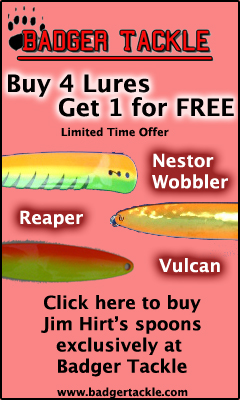

 Subscribe

