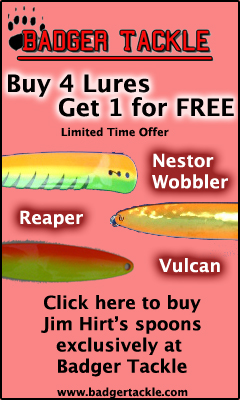
April fishing is very good. Most of our charter trips are catching limits on Lake Trout with a few Browns. Clear skies with the wind out of the west at 15-25 mph have been the norm. The water flowing into Milwaukee harbor is 58 degrees. We have been fishing the temp breaks in front of the river mouth and harbor gaps and north of Milwaukee in 35 to 50 feet of water. Lots of bait fish around. Our best presentations are 3,4,5,and 6 color Cortland lead core and downriggers 20 to 35 feet down. The fish have been mostly been on magnum spoons. The Reaper Magnum Peacock Silver spoon by Badger Tackle have caught most of our fish sold athttp://www.badgertackle.com Michigan Stinger Jawbreaker and most of their silver orange spoons are also working for browns. Depending on wind direction the north and south gaps are producing fish. Our bigger Chinooks have been caught at the north gap. The fish at the north gap came on small Vulcan spoons. Silver blue spoons worked best for us running 60 feet behind the ball on downriggers 8-15 feet down. Our best boat speed was 2.4 mph. Slide Divers are producing very well set to #1 with 20 feet of line out. Have a great fishing season. Let’s go fishing!! Jim charters out of Milwaukee, WI. with Blue Max Charters. He can be reached at 414-828-1094 or visit his web site at http://www.bluemaxcharters.com Copyright© 2010, James J. Hirt, All Rights Reserved.
Opening for Trout and Salmon Fishing
During my charter fishing year I get request from individuals that are looking for other anglers to join them and share the expense of the charter. Currently I have two openings 0n April 21st morning or afternoon and April 23rd morning or afternoon. The cost would be $120 plus tax for a five hour charter all equipment furnished license extra. Call me Jim Hirt 414-828-1094. We are catching Lake Trout 8-9 pound average. Brown Trout 4-6 pound average and some Rainbow Trout 7-10 pounds. We fish out of Milwaukee Wisconsin please go to my http://www.bluemaxcharters.com website for more information or call.
In previous articles we covered where to start if you have not been out for awhile. In this article I would like to help you with what lures to buy at the tackle store for a typical July or August trip on Lake Michigan. This is a very difficult question. Where I cannot possibly go into all species and all situations, perhaps I can define what I believe will catch fish 90 percent of the time. Please keep in mind that the best lure not properly presented will not catch fish. Milwaukee is known for excellent Chinook salmon fishing, so I will focus on salmon. If I were to run just one lure day in and day out and consistently catch fish, it would be a flasher and fly. Flashers come in dozens of colors and sizes. The one I would select would be an 8-inch Luhr Jensen green with silver and glow tape with a green fly. The length of the leader from the flasher to the fly should be give or take 25 inches. I measure from the end of the hook to the back of the flasher. This measurement may change day to day. The length of the leader will affect the speed of the fly movement. The bigger Chinooks may require a longer leader. My number two choice would be two different spoons. For first light fishing I like a Reaper Magnum Fish Fry Glow. This spoon has put more fish in the cooler than any other spoon I run. The other spoon I like is a Vulcan Magnum or Regular Silver with blue and green accent both are available at badgertackle.com. Use this lure when fishing in over cast situations or below fifty feet down. Run a spoon on your dipsey and flasher flies on your downriggers. A simple and very effective way to produce fish on calm days with clear skies is to run just two spoons. The lead from the spoon to the downrigger should be one hundred fifty feet. This presentation will not allow tight turns. When the morning bite stops, go long to continue catching fish. Good Luck Captain Jim. Let’s go fishing!! Jim charters out of Milwaukee, WI. with Blue Max Charters. He can be reached at 414-828-1094 or visit his web site at http://www.bluemaxcharters.com Copyright© 2010, James J. Hirt, All Rights Reserved.
Resources
In previous articles we covered basic leadcore. I would recommend trying a leadcore line set up. This presentation will work when all others are dead. In this article I would like to explain where to start if you have not been out for awhile. I find Internet fish reports invaluable for up to date information look for the most recent reports. If you do not have that option, ask at the local sporting goods stores or the other fisherman at the launch ramps. Marine radio is also helpful if you have one.
Tools
What if none of these options are available? Then follow the steps I recommend. The tools you will need are depth gauge, temp gauge and fish locator. I key on temp and food. In most cases when you find them you will catch fish. Start with a temp check on the surface. If it is too warm for your target species, you must take a temperature check from the top to the bottom in the water you are in to see if it is cold enough for your target.
How To
East wind will bring warm water into Milwaukee. The result may be water that is too warm for your target. When you find this scenario move out to deeper water and check again. Repeat this process until you are satisfied with the temp. Look for a sharp break in temp from the warm surface to the colder water. I work tackle both slightly above and below the break. Having said that, there are exceptions to every rule. I would also run one line well above and below the temp break. This may be out of the temp you expect to catch fish, but at certain times of the day they will be there.
Lures
Run your most aggressive lures with the most action on the warm side of the break. In contrast, use slower less aggressive tackle on the extreme cold side. Baitfish are a very important ingredient to this mix. Always fish schools of baitfish when you see them. When you are under power on the way out and see baitfish on the locator get the lines in. Good Luck Captain Jim. Let’s go fishing!! Jim charters out of Milwaukee, WI. with Blue Max Charters. He can be reached at 414-828-1094 or visit his web site at http://www.bluemaxcharters.com Copyright© 2010, James J. Hirt, All Rights Reserved.
Here are some ways to present lures in spring. This time of year look for most of your fish in the top 50 feet. Keep your eye on your locator and also work deeper marks when you see them. My experience this time of year is the deeper fish are less active and tend not to bite. Most often you will not mark well above 30 feet because those fish are out side the cone of your locator’s transducer. The primary presentations I use at this time of year are Church Tackle Walleye boards, Slide Divers and leadcore. If your budget allows, I would recommend trying a leadcore line set up. This presentation will work when all others are dead.
Basics
The basics of leadcore are simple. The most expensive part is the reel. It must have enough line capacity to handle the leadcore line plus Seaguar fluorocarbon and Power Pro 50 pound for a total of anywhere from 300 half core to 600 yards two cores. I run my half cores or five colors on a reel that holds 300 yards of 20 pound test. This is the smallest reel a half core will fit on. Line counter reels are not necessary. Leadcore sinks at a rate of 4-5 feet per color. A half core will run about 24 feet deep.
Loading the reel
When loading this reel, start with 300 yards of Power Pro 50 pound then strip the lead out of the end of the leadcore and tie a Willis Knot to the leadcore. Finish with a Willis Knot and 30 feet of a 20-pound Seaguar fluorocarbon to a ball bearing cross lock snap. You will need a heavy action 8-foot rod to work with lead. You may run this with a Church Tackle Walleye planer board if you are going to use multiple set ups.
Presentation Tips
Snap on your favorite lure and let out all of the line to the Power Pro. Then install your board so it does not release. I usually run them 150 feet off each side of the boat. Very wide turns and low boat traffic are a must to avoid tangles and getting run over. I set my drags light. When the reel starts to scream, adjust the drag as necessary. Reel in the line until you can reach the board and hand release it. Now the line is clear to bring in the fish. I don’t fish lead early in the morning. I use it when the early bite is over. Some of my biggest fish are caught on this presentation. Good Luck Captain Jim. Let’s go fishing!! Jim charters out of Milwaukee, WI. with Blue Max Charters. He can be reached at 414-828-1094 or visit his web site at http://www.bluemaxcharters.com Copyright© 2010, James J. Hirt, All Rights Reserved
In previous articles we covered spring presentation and location. As we go into summer our presentation evolves to follow the temperature of the fish you are targeting. This time of year look for most of your fish in the top 40 feet. Keep your eye on your locater and also work deeper marks when you see them. My experience this time of year is the deeper fish are less active and tend not to bite. Most often you will not mark well above 30 feet because those fish are out side the cone of your locater’s transducer. The primary presentations I use at this time are planer boards, dipsey divers and leadcore. On all my rods in spring, I run a 20-25 pound test monofilament with a 12-pound leader. You need to go with a light leader to produce good action in clear water near the surface. Run the heavier test to a bead chain sinker or barrel swivel then an 8-foot leader with a cross lock snap. Starting out this way I will have the rods loaded with the correct line for most presentations later in the season. I use a standard dipsey set up with an interesting twist. Opti-Dodger has a clear snubber, which I run right behind the dipsey and then 8 feet of 25-pound mono to the snap. The purpose of the snubber is to reduce the shock of the strike on the monofilament and it stretches initially to recoil and set the hook into the fish I am almost 100% on the number of hits to fish boated with set up. When I get those ugly days that the action slows I throw in my leadcores. It is not a presentation that is fun to reel in fish on. 500 feet of line is a lot of cranking. Leadcore will produce when nothing else will. I will go into details on set up and running lead in the next article. Jim charters out of Milwaukee, WI. with Blue Max Charters. He can be reached at 414-828-1094 or visit his web site at
http://www.bluemaxcharters.com Copyright© 2006, James J. Hirt, All Rights Reserved.
In previous articles we covered general overview and the specifics of temperature breaks and their location. Now let’s continue with spring presentation and location. If your season starts early as we do at Blue Max Charters, you will be on Lake Michigan when the surface temperatures are below the preferred temp of your target species.
I will cover late May and early June in this article. This time period provides great action on Brown trout, Chinooks, Coho and Rainbows. Browns, at this time of the year, will come on similar presentations, lures and locations as I described in the last articles. Look for temp breaks with bait fish and the warmest water. This time of year you won’t find water that is to warm for Browns. I like small Vulcan spoons with silver, green or white blades with green, orange or blue accent stripes. Work the top 25 feet of water.
Presentation for cold water
I set up 90% of my lines on planer boards working the top fifteen feet of water. The remaining 10% of my lines are on diving planers or downriggers for deeper fish. On all my rods in spring, I run a 20-25 pound test monofilament with a 12-pound leader. You need to go with a light leader to produce good action in clear water near the surface. Run the heavier test to a bead chain sinker or barrel swivel then an 8-foot leader with a cross lock snap. I don’t go nuts with Micro Filament or Super Braid lines because I think they are over kill for this application and add to expenses. Starting out this way I will have the rods loaded with the correct line for most presentations through out the season
Speed part of the answer
I set my boat speed at 1 to 2 mph. Slow presentation is key in spring. The lures you run is all about the amount of light, baitfish size and the size of fish you are looking to catch. Mix it up! When one lure produces I would double up on that lure. For Coho I prefer 6 inch orange flashers and a variety of different colored flies instead of spoons. Adjust the length of the leader from the flasher to the fly to get the best results. The general rule is one and one half times the length of the flasher. My experience is the colder the water the longer the leader. Longer leaders slow down the action. There are times when I run up to three times the flasher length. Most Rainbows will hit the flasher flies. When only looking for Rainbows, substitute bright color spoons for flasher flies. The Chinooks should also take spoons. Jim charters out of Milwaukee, WI. with Blue Max Charters. He can be reached at 414-828-1094 or visit his web site at http://www.bluemaxcharters.com Copyright© 2010, James J. Hirt, All Rights Reserved
Exploring the different types of hooks I use on Lake Michigan and the techniques I use to sharpen them. This is a somewhat controversial issue for most fishermen. Everyone has an opinion I can only state what works for me. One thing I believe all will agree on is a sharp hook will catch more fish. There are many types of sharpeners out there. I have tried most of them. A simple $4.00 file is the system I keep coming back to. Start with a check of the point by trying to stick the tip into you thumbnail. A hook that slides off your nail needs some work. Do not shortcut this process 10 hits and 9 fish is a good day 10 hits and 2 fish you wasted your time coming out on the lake. File three sides of the point and test again. New lures do not always have sharp hooks! After you have boated a fish check the hook for sharpness and that it didn’t get bent out of shape. A word of caution if you loose the tip of the hook from repeated sharpening it’s time to replace it. This is the first step for any type of fishing and I guarantee it will improve your number of fish in the box. When you shop for hooks buy quality extra strong hooks. It should say 2x or 3x on the package. There are cheap hooks that bend easily and won’t hold a sharp point look for the best. A recent trend is to use red hooks in theory this makes sense. I do not have an opinion on this. I will be testing this on some baits this season. Always replace hooks with the same size you removed or the action will change. This leads us to the big question single hooks verses trebles. My rule is this stay with the original manufactures recommendation, they do the testing and that’s good enough for me. Good luck. Jim charters out of Milwaukee, WI. with Blue Max Charters. He can be reached at 414-828-1094 or visit his web site at
http://www.bluemaxcharters.com Copyright© 2010, James J. Hirt, All Rights Reserved.
Tags: Hooks
 Hooks | captjim |
  March 23, 2010 6:49 pm |
  Comments Off on Hooks Make the Difference
Your primary tool, and one you cannot do with out, is a surface temp gauge. I use the one built into my fish locator. It also has a graph to show the temp history over the last hour. This may not be necessary but it can help when mapping temp over a given area. The big pond is very cold in April and May also some years even into June. Your ability to monitor temp and stay in as close to the target species preferred temp will make or break your day on the lake. Let us assume most of the lake is in the forty-degree range and your target species is Coho, browns or Chinooks. All of these fish are looking for two things, temperature as close to their preferred range and food. I will go into food and or forage in another article for now let’s focus on temperature. Out of Milwaukee we are fortunate to have several rivers flowing into a large harbor. The rivers warm earlier than the lake and the mouth of a river is a place to start with a temp check. In addition, you should be checking each of the three gaps in the break wall that creates the harbor. A south wind will push the warm water out the north gap. This will turn the fish on in this area while the south gap is too cold for productive fishing. The way I start any day is to work the warmest water or water nearest to preferred temp I can find. After working this water, I move to cooler water. Sharp temp breaks are usually better at holding fish then gradual changes. Always consider the wind direction, not only when you are fishing but what it has been doing over the last several days. A light east wind on our western shore moves warmer surface water on shore and contributes to a rise in temp and a good bite close to the shoreline. All harbors with rivers have some current flow and the wind determines the direction that warmer water will flow when leaving the harbor. Fish that warmer water and into the cooler lake water keeping an eye on your temp gauge. When you get action note your location by land sightings and temp. Stay with that temperature to find active fish. If you have worked the harbor and gaps with no or slow action, look for temp breaks on the lake created by shifts in wind direction. Another option is to check tight along the shoreline in protected bays. At times I will run my lures in the shallow warmer water on side planners keeping the boat out in the deeper cooler water. Another area to check out is any warm water discharged from power plants. We have this opportunity south of Milwaukee by twelve miles at Oak Creek. I will go into details of spring lure selection and presentation in the next article good luck Copyright© 2010, James J. Hirt, All Rights Reserved.
Motor trolling is the method I use for most of my fishing, and I will explain one of my basic spring setups. If possible I would max out the number of rods, because more is better this time of year. I fish all my lines on planer boards. Find one you like and run all the same type. For lures I like spoons crank baits, and jointed minnow type lures. These will cover most fish. The water is too cold for flasher flies and they will be used when the water warms to over fifty degrees. When fishing early in the season, fish metabolism or body temp is very low so a slow presentation is required. I run my boat speed between 1.5 and 2.0 miles per hour. The color of the lure is dictated by the amount of light and water color. On most days, in clear water I use white and black or silver lures. Hotter colors work best in cloudy water. You can’t go wrong with chartreuse in both conditions. The new glow in the dark Vulcan or Reaper spoons sold at
http://www.badgertackle.com in regular size are an excellent option. The old rule of thumb applies; bright lures bright days, dark lures dark days. I cannot cover all the bases in this limited space so I will go into more detail in future issues. Good luck Captain Jim. Jim charters out of Milwaukee, WI. with Blue Max Charters He can be reached at 414-828-1094 or visit his web site at http://www.bluemaxcharters.com Copyright© 2009, James J. Hirt, All Rights Reserved.

 Subscribe

